
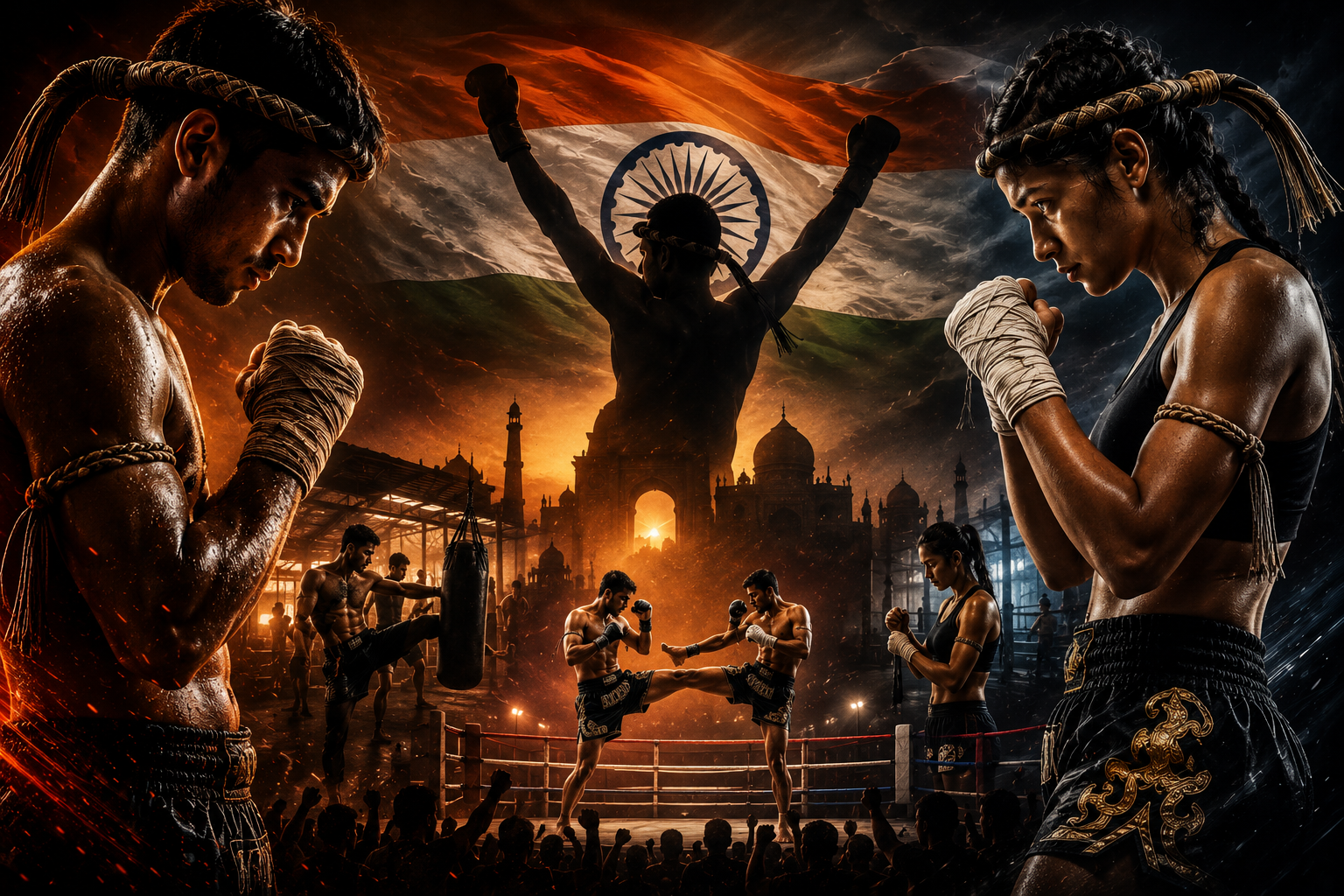
There was a time when striking sports in India began and ended with Western boxing and traditional Olympic wrestling (Pahlwani). But over the past decade, a quiet revolution has taken over combat sports centers from the mist-covered hills of Meghalaya to the bustling martial arts hubs of Bengaluru and Mumbai.
Muay Thai—Thailand’s ancient “Art of Eight Limbs”—has rapidly expanded across the Indian subcontinent. What started as a niche training method for dedicated mixed martial artists has matured into a structured ecosystem complete with national sanctioning bodies, WBC-recognized title belts, and international podium finishes.
Today, Indian Muay Thai Fighters are no longer just participating on global stages; they are capturing world championship medals and proving that Indian striking belongs at the highest level.
The Evolution: How Muay Thai Took Root in India
To understand the surge of Indian Muay Thai Champions, you have to look at the unique appeal of the discipline itself. Unlike traditional kickboxing, Muay Thai incorporates punches, kicks, knees, elbows, and intricate stand-up clinching. That variety makes it arguably the most effective striking art in combat sports.
India’s growth in the sport can be traced back to two major catalysts:
-
The MMA Boom: As promotions like Matrix Fight Night (MFN) and ONE Championship grew popular across South Asia, Indian fighters realized that standard boxing punches weren’t enough. To survive in the cage, they needed the devastating leg kicks, teeps, and clinch control that only pure Thai boxing provides.
-
Grassroots Academies & Authentic Coaching: Serious practitioners stopped relying solely on generic martial arts instruction. Dedicated coaches began making frequent trips to Bangkok, Phuket, and Chiang Mai to earn authentic Kru certifications and bring traditional training protocols back home.
Legendary Pioneers and Rising Indian Muay Thai Champions
The rise of any combat sport relies on trailblazers who clear the path for future generations. India’s striking scene features several notable athletes who have earned their place in history.
1. Surya Sagar: India’s WBC MuayThai Pioneer
When discussing professional Muay Thai in India, Surya Sagar’s name is front and center. Training out of the Academy of Martial Science in Mysuru, Sagar etched his name into the history books in September 2021 by becoming the first-ever WBC MuayThai India Champion in the Super Lightweight division.
In a high-stakes title fight at Fraggingmonk Fight Night-2 in Bengaluru, Sagar scored a first-round stoppage, securing the world-recognized WBC green and gold national belt. Beyond his domestic title, Sagar was also the first Indian fighter to secure a victory at the iconic MAX Muay Thai Stadium in Pattaya, Thailand, proving that Indian athletes can compete on authentic Thai soil.
2. Thiru Balachandra: World Champion Glory
Hailing from Chennai, Thiru Balachandra made history at the 19th World Muay Thai Championship organized by the World Muay Thai Federation (WMF) in Thailand. Competing against elite international talent, Balachandra fought through a grueling tournament bracket to capture a Gold Medal world title belt for India, establishing a benchmark for aspiring striking talent across Tamil Nadu and South India.
3. Kabita Devi Toljam: Leading the Women’s Division
Northeast India has long been a powerhouse for Indian combat sports, and Manipur’s Kabita Devi Toljam represents the finest of that tradition. Representing Team India on the IOC-sanctioned amateur circuit, she captured a prestigious Silver Medal in the U-24 Female division at the IFMA Senior Muaythai World Championships. Her victory highlighted the technical skill of India’s female combat athletes on the global stage.
4. The IFMA World Championship Medalists
The amateur international circuit—regulated by the International Federation of Muaythai Associations (IFMA)—has seen a steady stream of Indian podium finishes. Athletes like Sarita Choudhary, Suman Tomarwat, and Mohit Verma have consistently earned medals at Asian and World Championships, demonstrating that India’s national team possesses the cardio, conditioning, and technique to hold its own against historic Muay Thai powerhouses.
National Structure: Sanctioning Bodies and Muay Thai Competitions in India
A sport cannot thrive on individual talent alone; it requires organized structure, fair ranking systems, and official competition pathways. India’s Muay Thai landscape is governed by two prominent organization tracks:
United Muaythai Association India (UMAI)
As the official national governing body recognized by IFMA (which holds official IOC recognition), UMAI regulates amateur Muay Thai across Indian states.
UMAI hosts official Sub-Junior, Junior, and Senior National Championships. For instance, UMAI organized the 7th Senior National Muaythai Championship in Hyderabad, bringing together hundreds of athletes across Elite, Under-23, and Para divisions. Participation in UMAI national championships is the mandatory gateway for fighters aspiring to represent Team India at the IFMA World Championships, Asian Muaythai Championships, and the World Combat Games.
WBC MuayThai India & Golden Mongkhon International (GMI)
For fighters looking to turn professional, organizations like WBC MuayThai India and Golden Mongkhon International (GMI) provide structured pro ranking pathways.
GMI regularly hosts events like the Golden Mongkhon Title Belt Championship and national selection tournaments in Bengaluru, offering official title belts, video review systems, and sanctioning that connects Indian fighters directly with the World Muay Thai Federation (WMF) in Bangkok.
Key Regional Hotbeds for Indian Muay Thai
While Muay Thai is practiced across the entire country, specific regions have emerged as major centers for high-level training and athlete development:
INDIAN MUAY THAI REGIONAL MAP
------------------------------------------------------------------
Region            | Key Strengths               | Notable Hubs
------------------|-----------------------------|-----------------
Northeast India   | High natural agility, deep   | Meghalaya, Manipur,
(Meghalaya, etc.) | combat traditions & stamina  | Assam, Mizoram
------------------|-----------------------------|-----------------
Bengaluru &       | Modern academies, foreign   | AMS, Fraggingmonk,
Karnataka         | guest coaches, pro promotions| GMI Headquarters
------------------|-----------------------------|-----------------
Maharashtra       | Heavy MMA integration,      | Mumbai, Pune,
(Mumbai/Pune)     | high-volume fight nights    | Navi Mumbai
------------------|-----------------------------|-----------------
Tamil Nadu        | Strong striking roots, WMF  | Chennai,
& Kerala          | tournament development      | Coimbatore
The Northeast (Meghalaya, Manipur, Mizoram)
The northeastern states have naturally gravitated toward Muay Thai due to a long-standing regional tradition of martial arts. Athletes from this region are known for their exceptional footwork, conditioning, and relentless pacing in the ring.
Bengaluru (The Fighting Capital of South India)
Bengaluru has earned a reputation as the primary staging ground for major Muay Thai Competitions in India. Home to organizations like GMI and elite training centers like the Academy of Martial Science (AMS), Bengaluru regularly hosts multi-day national championships, title belt bouts, and seminars conducted by visiting Thai Krus.
Inside a Training Camp: How Indian Fighters Prepare for the Ring
Training to become one of the top Indian Muay Thai Champions requires incredible discipline. A typical day in a high-level Indian fight camp mirrors the intensity of authentic Thai gyms:
-
Morning Conditioning (5:30 AM): A 5km to 10km run to build cardiovascular endurance, followed by shadowboxing and 5–6 rounds of heavy bag work focusing on low kicks and middle roundhouses.
-
Pad Work & Technique (10:00 AM): Intimate one-on-one sessions with a trainer holding Thai pads, working on timing, counter-striking, and level changes.
-
Clinch & Sparring Sessions (4:30 PM): Sweaty, grinding 45-minute clinch sessions where fighters work on collar-ties, sweep setups, and off-balancing opponents, followed by controlled technical sparring.
-
Recovery & Mental Prep: Body conditioning using wooden rollers on shins, ice baths, and video analysis of upcoming opponents.
Many top Indian Muay Thai Fighters spend several weeks each year in Thailand training at famous gyms like Tiger Muay Thai, Fairtex, or PK.Saenchai. They absorb the authentic culture, adapt to the heat, and bring cutting-edge techniques back to their home gyms.
The Intersection: Muay Thai and Indian Mixed Martial Arts (MMA)
You cannot talk about the growth of Muay Thai in India without addressing its impact on the country’s surging MMA scene.
Promotions like Matrix Fight Night (MFN) have showcased how crucial Thai boxing skills are inside a caged environment. Striking-centric fighters who lack Muay Thai clinch defense often find themselves trapped against the fence, taking heavy knees to the body or elbow slices in close quarters.
As a result, almost every elite Indian MMA fighter—whether competing in MFN, ONE Championship, or regional promotions—now spends significant time refining their Muay Thai basics. Understanding how to check a low kick, catch a teep, or trip an opponent from a double-collar tie has become mandatory for survival in modern combat sports.
Challenges Facing Muay Thai in India
Despite its remarkable growth, the sport still faces several hurdles that prevent it from achieving mainstream commercial status alongside sports like cricket or badminton:
-
Sponsorship & Financial Support: Most Indian Muay Thai Fighters still self-fund their travel, equipment, dietary needs, and fight camp costs. Securing corporate sponsorships for non-cricket combat sports remains a challenge.
-
Grassroots Equipment Access: While tier-1 cities have state-of-the-art academies equipped with fairtex gear, heavy bags, and proper ring setups, rural gyms often lack essential protective gear like shin guards, mouthguards, and quality pads.
-
Broadcasting & Media Reach: While domestic fight nights draw passionate live crowds, securing consistent television broadcast deals is crucial for taking the sport to millions of homes across India.
The Future: What Lies Ahead for Indian Muay Thai?
The trajectory of Muay Thai in India is undeniably upward. With UMAI streamlining national amateur pathways and organizations like WBC MuayThai India sanctioning official title belts, the infrastructure is stronger than it has ever been.
As Muay Thai edges closer to potential inclusion in upcoming Olympic cycles under IFMA’s recognized banner, India is positioning itself as an Asian striking contender. The next generation of young strikers in India isn’t just looking to learn self-defense—they are looking up to pioneers like Surya Sagar and Kabita Devi, aiming to win world title belts, and proving that India is a force in the Art of Eight Limbs.
Whether you are a casual fan of combat sports or an aspiring striker looking to step into the ring for the first time, there has never been a more exciting time to follow the rise of Indian Muay Thai Fighters.

